
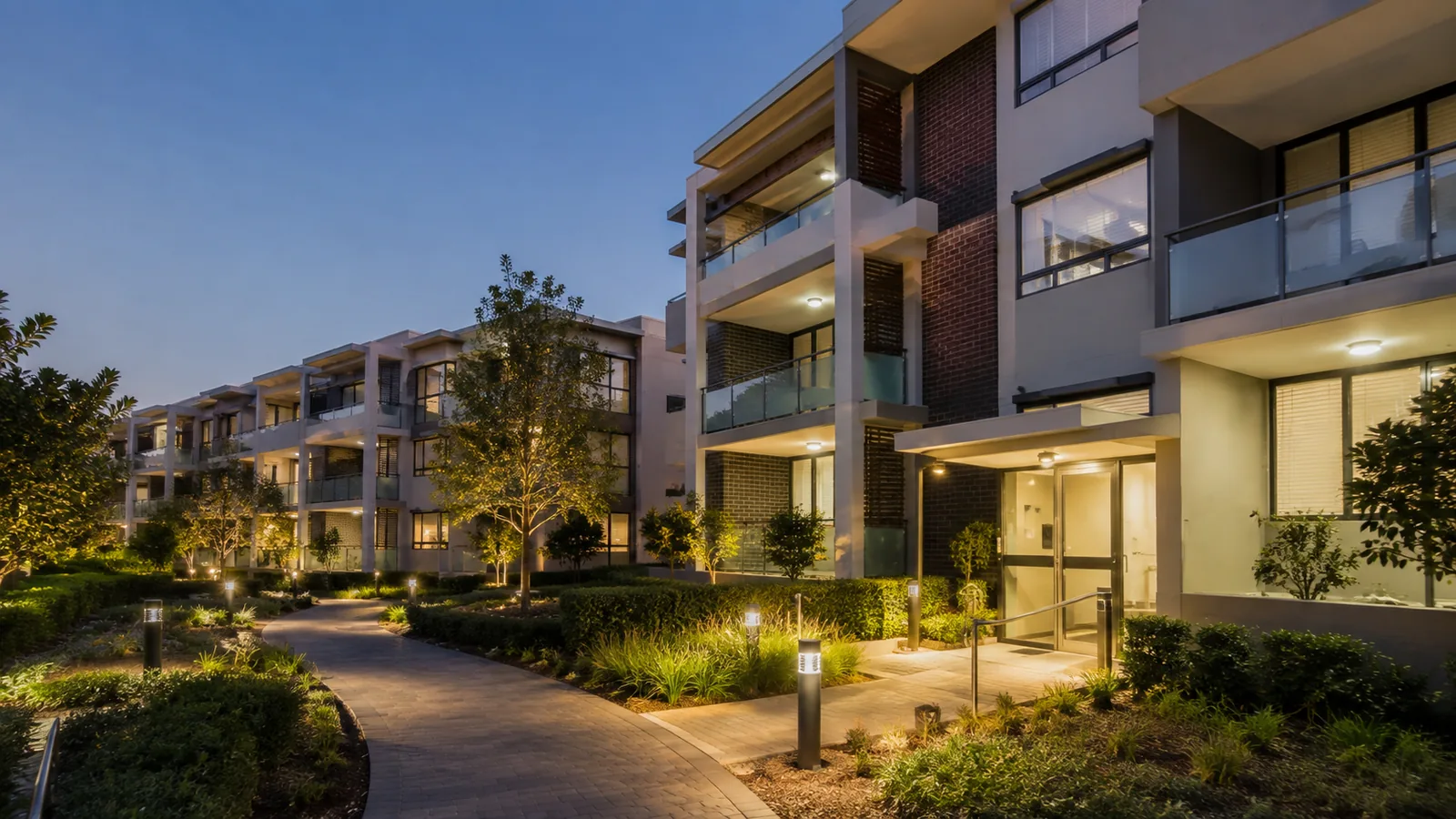
Fluorescent and halogen lighting is being phased out across Australia, and for strata buildings that creates a deadline no committee can ignore. A full LED upgrade improves safety, lowers running costs and future-proofs the building, yet many committees hesitate because they picture a large one-off cost drawn straight from the sinking fund.
It does not have to work that way. With the right funding model, a body corporate can complete an entire LED upgrade with little or no money upfront, let the energy savings cover the cost over time, and keep the sinking fund intact for the projects it was set aside for. This guide explains how the switch works, what it costs, and how to fund it.
At a glance
Can a strata building upgrade to LED without using its sinking fund? In most cases, yes. The building can fund the work through green energy-performance funding and, where eligible, state energy programs, then repay it from the energy savings the new lighting generates.
- Fluorescent lamps are being phased out by 2027 under the Minamata Convention on Mercury
- Funding can come from green energy-performance funding plus state programs (Victoria VEU, New South Wales ESS, South Australia REPS), subject to eligibility
- Repayments are designed to come from the energy savings, so the sinking fund is not drawn down upfront
Why an LED upgrade cannot wait before the 2025 to 2027 phase-out
Two things make the timing important right now.
The first is regulation. Under Australia’s energy efficiency rules and the Minamata Convention on Mercury, older and mercury-based lamps are being removed from the market on a fixed schedule.
| Lamp type | What is changing | When |
|---|---|---|
| Incandescent lamps | A range of mains-voltage incandescent lamps phased out | From October 2025 |
| Certain mercury lamps, including some compact and linear fluorescent lamps | Import, manufacture and export prohibited in Australia | Since March 2022 |
| All remaining fluorescent lamps, including common T8 and T5 tubes | Phase-out agreed under the Minamata Convention | By 2027 |
Sources: Australian Government Energy Rating and the Minamata Convention on Mercury. Confirm current product availability with your supplier.
Once a lamp type reaches its date it can no longer be manufactured or imported, so replacements become harder to find and more expensive. For buildings still relying heavily on fluorescent or halogen lighting, moving to LED is becoming unavoidable as those replacement lamps get scarce and costly.
The second reason is cost. As the deadlines approach, demand for electricians and for LED product rises, and prices tend to rise with it. Buildings that plan early can lock in better pricing and avoid the last-minute scramble.
LED versus halogen, fluorescent and CFL
Older lighting technologies waste much of their energy as heat, while LEDs use far less power to produce the same amount of light.
| Lamp type | Energy use | Contains mercury | Status |
|---|---|---|---|
| Incandescent | Highest | No | Phased out from October 2025 |
| Halogen | Very high | No | Older type, largely replaced |
| Compact fluorescent (CFL) | Moderate | Yes | Being phased out |
| Linear fluorescent (T8 and T5) | Moderate | Yes | Phased out by 2027 |
| LED | Lowest | No | Current standard |
General comparison of common lamp types. Phase-out status is per the sources listed above.
The practical differences for a building are clear. LEDs use less energy than the lamps they replace, contain no mercury, and last far longer, so maintenance visits and globe replacements drop and maintenance costs fall with them. They run cooler, which reduces the load on air conditioning and removes a heat and fire-risk factor in ceiling spaces. The light quality is better and more consistent, with no flicker or warm-up delay.
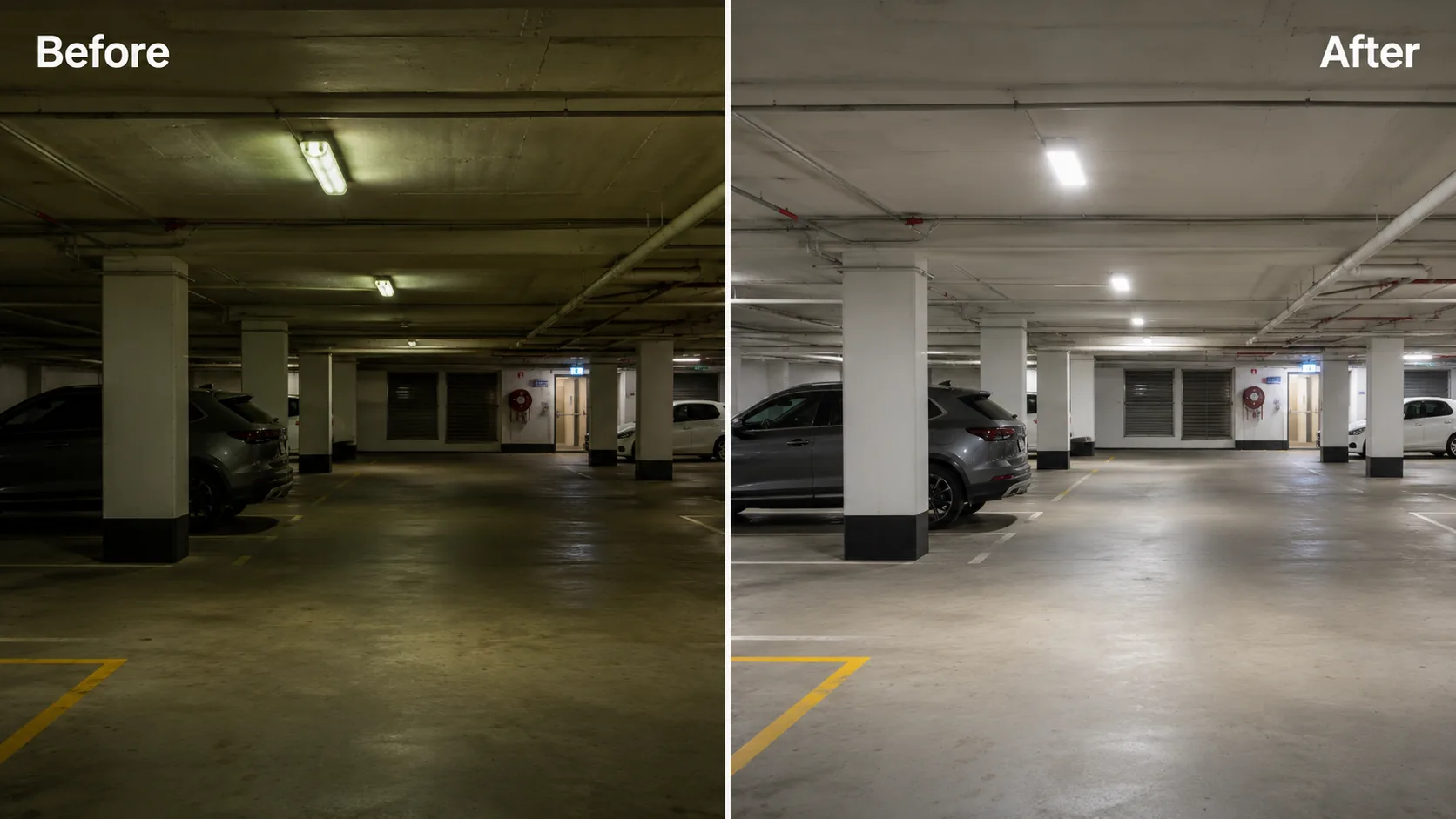
E&E Lighting’s LED fittings are rated for a lifespan of up to 100,000 hours, many times the life of the fluorescent tubes they replace. A full upgrade can cut a building’s lighting energy use sharply, which shows up as lower electricity bills and lower greenhouse gas emissions. The worked example further down puts real figures to that for one illustrative building.
How can a strata building fund an LED upgrade without touching the sinking fund?
This is the part that changes the decision for most committees. A full LED upgrade does not have to be a lump sum drawn from reserves. There are two funding paths, and they can be combined.
The self-funding model
Green funding, sometimes called energy performance funding, lets a building complete its upgrade with little or no upfront cost. A funding provider covers the project, and the building repays it from the energy savings the new lighting generates.
Because a well-designed upgrade cuts lighting costs immediately, repayments are structured to sit at or below the saving, so the project is close to cash-flow neutral from day one. The sinking fund is left untouched, the full upgrade happens now rather than in stages, and once the funding term ends the building keeps the entire saving.
Government rebates and incentives by state
Depending on the state, government energy programs can reduce the cost of a commercial or strata LED upgrade, and in some cases cover a large share of it.
- In Victoria, the Victorian Energy Upgrades (VEU) program provides incentives for approved lighting upgrades
- In New South Wales, the Energy Savings Scheme (ESS) offers incentives for eligible lighting projects
- In South Australia, the Retailer Energy Productivity Scheme (REPS) supports energy-saving upgrades, including lighting
Eligibility, product requirements and the size of the incentive change over time and vary by building, so confirm the current terms for your property before relying on them. You may see these promoted as free LED upgrades, but for most strata buildings the programs reduce the cost of the work rather than making it entirely free. Combined with green funding, they lower the amount to be repaid and shorten the payback period.
What an LED assessment includes
Every building is different, so a full upgrade should start with an assessment rather than a quote off a price list. A proper LED assessment inventories your existing fittings and lamp types and how each area is used, then projects the energy savings, including the effect of sensors and controls in low-traffic areas such as car parks and stairwells.
It also sets out a return on investment timeline and payback period, compares the funding options with a cash-flow model so the committee can see the numbers before deciding, and checks the building’s emergency and exit lighting compliance, which is a legal requirement and often overlooked. E&E Lighting provides the assessment at no cost.
A worked example that shows how a funded LED upgrade pays for itself
This is the part most committees want to see. It shows what happens to the building’s cash position, year by year. The short version is that a well-structured upgrade is slightly cash-flow positive from the very first year, and once the funding is repaid the saving jumps sharply.
The example assumes a $30,000 upgrade funded and repaid from the energy savings, a current lighting energy cost of $14,000 a year, a saving of $9,962 a year from LED with sensors (a 71 per cent reduction in this example), energy price inflation of 3 per cent a year, and the funding repaid across the first four years.
| Each year | Year 1 | Year 2 | Year 3 | Year 4 | Year 5 |
|---|---|---|---|---|---|
| Energy cost if you do nothing | $14,000 | $14,420 | $14,853 | $15,299 | $15,757 |
| Reduced LED energy cost if you proceed | $4,000 | $4,120 | $4,244 | $4,371 | $4,502 |
| Loan repayment from savings | $9,962 | $9,962 | $9,962 | $9,962 | $0 |
| Total outlay if you proceed | $13,962 | $14,082 | $14,207 | $14,333 | $4,502 |
| Net benefit versus doing nothing | +$38 | +$337 | +$646 | +$965 | +$11,255 |
| Cumulative benefit | +$38 | +$375 | +$1,021 | +$1,986 | +$13,241 |
Illustrative example provided by E&E Lighting Australia. The figures are general in nature and not financial advice. Committees should seek appropriate professional guidance before entering any funding arrangement.
Read the bottom two rows first, because they carry the story. While the savings are repaying the funding in years one to four, the building is already a little ahead each year rather than out of pocket, so proceeding never costs more than doing nothing. Doing nothing, by contrast, still costs about $58,572 across those four years in this example, and that figure keeps rising with energy prices.
By the end of year four the funding is repaid. From year five the building keeps the full saving, about $11,255 in that year alone, and it continues and grows with energy inflation every year after — before counting the lower maintenance costs and the avoided cost of chasing scarce fluorescent replacements. The sinking fund is never touched at any point.
Will LED work with your existing fittings?
One of the most common questions from committees and owners is whether the building has to be rewired, or every fitting replaced. Usually not.
- In many cases LED lamps fit straight into existing fixtures, though older or failing fittings are better replaced entirely for reliability and compliance. The assessment identifies which is which rather than replacing everything by default
- Some older dimmer switches were designed for halogen loads and can make LEDs flicker or buzz, so where dimming is needed an LED-compatible dimmer solves it
- A standard upgrade rarely requires switchboard changes, though any pre-existing switchboard faults should be corrected by a licensed electrician at the same time
- LEDs work well in older buildings and with existing wiring in the large majority of cases, and any exceptions are picked up during the assessment
You do not have to replace every lamp on day one. But for a building facing the phase-out, completing the full upgrade at once is usually cheaper and less disruptive than repeated partial works.
What should a strata committee look for in a quality LED upgrade?
Not all LED products are equal, and for a strata building the cheapest globe is rarely the best value. A compliant, well-made upgrade protects the committee and the owners.
Look for products designed and tested to Australian Standards. E&E Lighting fittings comply with AS/NZS 60598.1 for luminaires and, for emergency and exit lighting, AS/NZS 2293. E&E Lighting is an EESS registered supplier and a member of Lighting Council Australia and FPA Australia, and its fittings are backed by a five-year warranty and a seven-year design life. For a body corporate, that combination of compliance, warranty and long service life is what turns an upgrade into a genuine long-term saving rather than a repeat job in a few years.
Emergency and exit lighting deserves particular attention. It is a legal safety requirement in shared residential and commercial buildings, and an LED upgrade is the natural time to bring it up to standard alongside the general lighting.
Frequently asked questions
Are LED lighting upgrades worth it for strata buildings?
Yes. They lower energy and maintenance costs, improve safety and light quality, and they are becoming necessary as fluorescent and halogen lamps are phased out. With green funding the upgrade can be close to cash-flow neutral, so the case is financial as well as practical.
How much can we save on energy bills?
It depends on your building’s current lighting and how many hours it runs. The clearest illustration is the worked example above, in which a $30,000 upgrade produced an energy saving of about $9,962 a year. An assessment models the figure for your specific building.
Are the upgrades free, and what funding is available in VIC, NSW and SA?
Government programs such as the VEU in Victoria, the ESS in New South Wales and REPS in South Australia can reduce the cost, and green funding spreads the remainder across the savings. For strata buildings the work is rarely entirely free, but it can often be done with little upfront. Confirm current eligibility for your building before relying on any rebate.
How long do LED lights last?
E&E Lighting’s LED fittings are rated for a lifespan of up to 100,000 hours according to E&E Lighting’s product specifications, far longer than the halogen and fluorescent lamps they replace. That long life is where most of the maintenance saving comes from.
Do we replace whole fittings or just the globes?
It depends on the fitting. Many fixtures will take LED lamps directly, while older or failing fittings are better replaced. An assessment tells you exactly which, so you are not replacing entire fittings without reason.
Will LEDs work with our existing dimmers and switchboard?
In most cases yes. Older dimmer switches designed for halogen may need LED-compatible replacements to stop flickering or buzzing, and switchboards rarely need changes for a standard upgrade.
How long does an upgrade take, and do we need an electrician?
Yes, a licensed electrician carries out the installation. Most buildings are completed with minimal disruption, and the timing depends on the size of the building and the number of fittings.
Act now and book a no-cost LED assessment
The 2027 phase-out is close, and the buildings that act early will pay less and avoid the rush. If your building still runs fluorescent or halogen lighting, the first step is a no-cost assessment. E&E Lighting will inventory your lighting, model the savings and funding options, and check your emergency and exit lighting compliance, so your committee and body corporate management can make the decision with the numbers in front of them.
Contact E&E Lighting Australia to book your assessment and see how your building can upgrade to LED without draining the sinking fund.
About E&E Lighting Australia
E&E Lighting Australia is a 100 percent Australian-owned manufacturer and supplier of emergency, exit and LED lighting, established in 2017. Its products are designed and tested to Australian Standards including AS/NZS 2293 and AS/NZS 60598.1, and it is an EESS registered supplier (E6114) and a member of Lighting Council Australia and FPA Australia. You can see a selection of its work on the projects page.